Anatomy of a very long drive

After nearly two years we have said goodbye to the lesser-known but fifth member of our family: the car.

How do you pack for a two month road trip with the following criteria:

  • four people
  • summer through to winter conditions
  • swimming, camping, fishing, boating and hiking gear
  • assorted kids toys and entertainment
  • one night hotel stays through to seven-day fully self-catered stops
  • transport and consumption of vintage wine unable to be shipped home (obviously)
  • in a surprisingly small mid-sized vehicle
  • without taking four hours to unload and reload your vehicle each time

screen-shot-2016-09-19-at-10-34-10-pm(plus two kids in there somewhere….)

The answer is 1) with difficulty and 2) carefully.

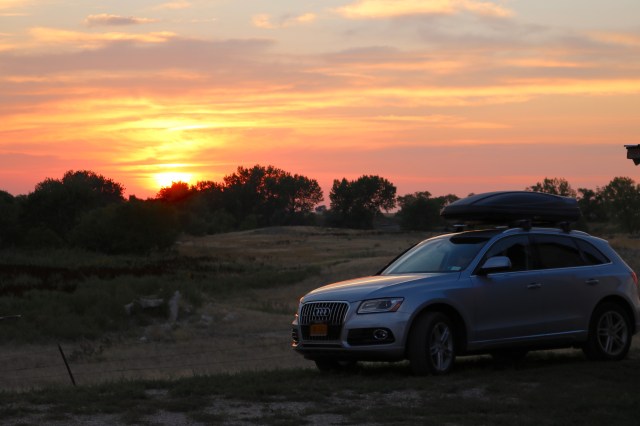
This component of the trip required a lot of pre-planning and thought, but has become remarkably well oiled.  We had some 24 bags of various size, shapes and purposes squeezed into the Q5 so that a) we could utilise every available piece of space and b) it allowed us to grab only what we needed for the type of place we were at, and the activities we were intending to do.  Everything had a very specific home to allow the roof and trunk to actually close.  A one-nighter took about half-hour to repack, the most elaborate stop-over took about two hours to get reloaded.

There’s obviously the minimum for any stop (Clothes, Valuables, Electronics, Toiletries), plus optional Swimming Gear.  But National Parks generally required the Hiking Grab Bag.  City breaks (art galleries, museums and restaurants) clearly required Dress Shoes.  Self-catered stops had any combination of Coffee & Cocktails, Cooking and the food Cooler grabs – or all three.  A bear-free country leg opened up Camping Gear.  Given some of the remote locations, the Emergency Grab Bag (Bear-spray, Torches et al) was re-assuring but fortunately little used.

Apart from the essentials, the things that we found super useful and well utilised for those considering something similar:

  1. B&O Speaker (essential jazz whilst sipping cocktails in a beautiful location)
  2. Expresso Coffee Maker (expresso each morning is not a treat, it’s a necessity)
  3. Coffee Thermos (drinking that same expresso in a National Park is a true luxury)
  4. First Aid Kits (scrapes, blisters, splinters and rashes are part of being outdoors)
  5. Bear Spray (not utilised, but very reassuring when you are remote and in grizzly country)
  6. Hiking gear (it’s rather dirty work being in nature)
  7. Water Shoes (there water, but it’s not all sandy beaches once you leave the coast)
  8. Cooler (eating something that isn’t fried, and for transporting that organic and gluten-free stash to somewhere less accommodating)
  9. TripAdvisor (where’s good to eat say about two hundred miles from here?)
  10. Kids iPads and Headphones (there’s only so much eye-spy and 6-8 year old music the car can bear).

Things that just didn’t get used – some surprisingly, some not:

  1. Travel Pillows (just one single hour nap in at least a hundred hours of driving?!)
  2. Running Gear (running in bear and mountain lion country is simply asking for trouble)
  3. Snow Gear (just lucky given snow both a week before and after in a couple of spots)
  4. Umbrellas and Raincoats (awesome; about 6 wet days in 8 weeks!)
  5. Yoga Mat and other assorted stretch equipment (what were we thinking!)

The Thule (the big black box on the top of the car) is on some old freighter on its long and slow journey home: finger’s crossed we see it again!

And we will be following shortly.


It’s Over

What an amazing experience and an immense privilege to have experienced the geography, the wildlife, the people, and simply just two months to get to know each other that much better.

Who knows if we will get two full months of such quality time again, for most it’s a rare luxury.

Well.  How to summarise 7000 miles, East to West, Alpine through Desert, Mountain and Lake, City and Parks?  We discussed this one at length….there wasn’t complete consensus between four very different personalities, but here is our best effort:

Most Awe Inspiring Destinations

  1. Yellowstone National Park
  2. Canadian Rockies
  3. Glacier National Park
  4. Jackson Hole and the Grand Tetons

Best Adventures

  1. Waterpark adrenalin
  2. Trail Riding in Backcountry Montana
  3. Whitewater Rafting on the Yellowstone River
  4. Rope Climbs and Bungy

Most Novel Experiences

  1. Digging for Dinosaurs in Thermopolis
  2. Jackson Hole Rodeo
  3. Seaplane Flight over Moosehead Lake
  4. Surrounded by Buffalo in Custer State Park

Lump in the Throat Moments

  1. Mount Rushmore
  2. Badlands National Park
  3. #21 and #42 Wolf Love Story
  4. Leaving New York City

Coolest Driving

  1. Maine backroads
  2. Wyoming and Montana wilderness
  3. Canadian Rockies (Trans Canada Highway)
  4. The Prairie (I-90)

Wildest Wildlife

  1. Buffalo
  2. Moose
  3. Bears
  4. Prairie Dogs

Things We Learned

  1. Lewis and Clarke Expedition
  2. Lots of Geology
  3. All kinds of Junior Ranger stuff
  4. Dinosaurs

 Just Plain Fun

  1. Birthday around the firepit in Maine
  2. Dressing up in 1880 Town, South Dakota
  3. Millennium Park, Chicago
  4. Swimming

Alpine Magnificence

It’s always good to end on a high note, and apart from a final wind-down in Vancouver, our leg in the Canadian Rockies was always going to be the psychological end of our trip.   And what a fitting end!

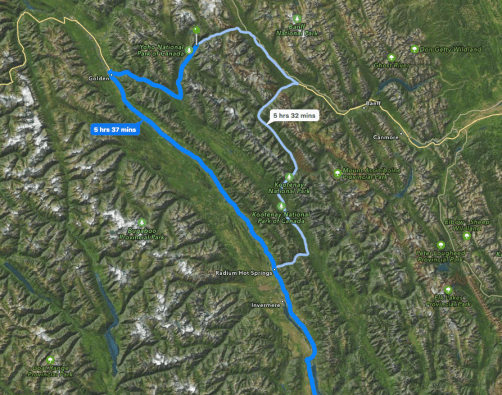
After leaving Glacier National Park, we travelled for hundreds of kilometres up a single enormous glacial valley with mountain ranges on either side (see the satellite pic below).  Neither of us had seen such features of the Earth’s continental activity before on such as massive scale.  Two plates crashing together have pushed the Rockies to their current (and increasing heights), whilst vast glaciers carved the U-shaped valleys and sharp peaks that are a feature of this end of the range.

screen-shot-2016-09-20-at-8-57-50-pm

We have seen many beautiful parts of Northern America on this trip, but the Canadian Rockies have taken our prize for the most spectacular.

We stayed in an intimate lodge in the Kicking Horse valley, under the shadows of Cathedral Mountain – a pass famous for being the most difficult piece of railway track on the Canadian Pacific Railway’s route.  Just above us were two spiral rail tunnels, built to allow a train to climb or descend the steep grade (the infamous ‘Big Hill’) by circling around and over themselves in a figure eight structure under the mountains.

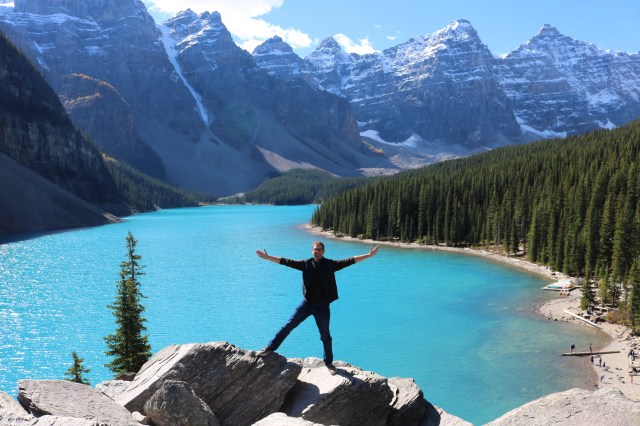
Banff was beautiful, but our favorite was the brilliant blue waters of Lake Moraine, and the busier but grand Lake Louise.  We rode the chairlifts and tried to spot grizzly, and although no bears the view of the mountains from the top was absolutely worth it!  We spent some time warming our bones in Banff Hot Springs, and generally just relaxed, savouring some really good food.

Canada has been a great transition for us – there’s a lot of similarities to Australia (I guess it’s the Commonwealth thing, not just the fact that everyone in the  service  industry has been Aussie!).  One big surprise for us has been Canadian wine!  Who knew?  But it is great, they should export it!

This is a magical part of the world and fantastic that it is largely protected for the future.  All Canadian Rockies photos here: next and final stop, Vancouver!

Going to the Sun

In 1933, at the height of the Great Depression, President Franklin D Roosevelt lobbied Congress and received approval to setup a temporary agency entitled the Civilian Conservation Corp.  Its mission – apart from providing work, pay and rations to large number of unemployed men, was to conserve and develop natural resources across the country – a country suffering from severe environmental degradation in many parts.

The CCC turned out to be the most popular of the New Deal work relief programs – hard work but rewarding.  Participants were paid $30 per month, and were required to send back at least $25 of this to dependents.   There were few requirements: participants had to be healthy, unmarried men, between the ages of 18 and 25, and their families had to be on local relief rolls. They had to be between 5 feet and 6 feet 6 inches tall, weigh over 107 pounds, and they had to have at least six teeth.

Under the 9 year life of the program, America planted nearly 3 billion trees to reforest swathes of the country – they built many of the campsites, fire-towers, ranger stations and roads that support the US National Park system today.

One such byway – the Going to the Sun Road sits in Glacier National Park.  This engineering feat crosses the continental divide at Logan Pass (6646 feet), crossing the park from East to West.  It’s a spectacular road, with massive vistas in every direction as you wind your way through the park.  Unfortunately for us, there had been some cold weather and snow prevented us from doing the complete route, although we saw the majority.

However, we loved what we did see, and we did a couple of very pretty walks.  The awesome open top red buses from the 1930s that ferry visitors along the road are a brilliant sight against the green, blue and white colours of the mountains, and a historic link.  The park really is the “Crown in the Continent” – pristine alpine scenery, arguably the most beautiful we have seen so far.  It is very hard to capture the sheer scale of these canyons and peaks in photos.  The weather has also turned rather crisp to match – the crackling wood fire each night in our chalet is lovely!

The kids have started experiencing park fatigue, they struggle to turn their heads for mere bison or elk…“tell us if you see a grizzly”.  This became apparent to us when Ana looked out one morning and piped up: “how long have we been in the car”?  Mmm, 15 seconds Ana.

Another exchange discussing iPads which are not allowed in the National Parks (trip rule):

Vanessa: I’m not interested in Minecraft, I only like things that are real, like this beautiful scenery.
Amelie: Minecraft is real.  REAL AWESOME!

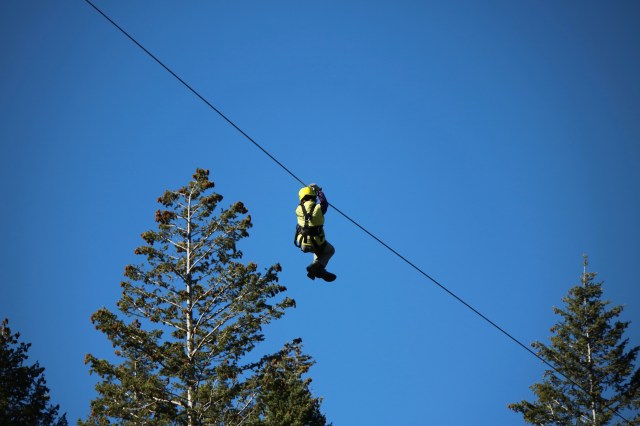
To add a little balance, Amelie and Daddy embarked on an exhilarating Zipline adventure, and we also spent some time simply hanging out (in a mixture of warm sun and a hailstorm!) in Whitefish, a very cute little Montana town.  Glacier has few roads, but is a hiker’s paradise – we can see ourselves returning to this park at some point in the future.

img_9681

All Glacier photos are here:  our penultimate stop – the Canadian Rockies  – is next.  A potential rival to the grandeur of America’s Glacier NP?

America’s Best Idea

“National parks are the best idea we ever had. Absolutely American, absolutely democratic, they reflect us at our best rather than our worst.” [Wallace Stegner, Author, 1983]

As the National Parks Service celebrated its 100th Anniversary this year, it’s been fitting for us to visit the one that inspired them all, the world’s first: Yellowstone.

In 1869 this area was still an unknown and unexplored part of the country.  In just three years and three expeditions, the remarkable wonders of this area had resulted in the creation of a vast public and protected expanse – nearly 3,500 square miles (9000 sq kms) of spectacular lakes, mountain ranges, canyons, rivers and plains.  Bridging the continental divide, it sits atop one of the world’s largest active super volcanoes and contains half the world’s geyser’s.  In an era of unchecked development, it was a visionary and bold step; one that would set a precedent emulated around the world.

It’s difficult to capture both the sheer scale of this park, and the varied concentration of unique and beautiful geographies in one location.  It takes hours to drive just a quarter of it – but it is an ever changing catalog:  winding along a pristine rushing river, climbing through conifer forests, descending immense glacial valleys, being enveloped by steam from geothermal hot springs and then looping through desert-like landscapes.

And of course the wildlife.  Yellowstone is part of the Greater Yellowstone Ecosystem which includes YNP, but also encompasses Grand Teton NP, five bordering National Forests (and their included Wilderness Areas) and the National Elk Refuge in Jackson – around ten times the area of the park itself.  This is one of the last large remaining intact ecosystems in the northern hemisphere, home to most of America’s megafauna.

Elk, mountain lion, mountain goats, big horned sheep, deer are all there.  Bison roam in healthy numbers – even though by 1902 there were only about two dozen remaining in Yellowstone until the US Army critically stepped in to protect them.  Wolves were exterminated from the park in a misguided but managed program to protect Elk, but in one of the more successful conservation efforts were reintroduced back in 1995.   Yellowstone was also a key component of successful efforts to protect the endangered Grizzly Bear.

After a very unsociable early start, we enjoyed a really poignant guided tour by Shauna from the Yellowstone Association.  She had been studying the wolf population for 13 years, and had immense insight and knowledge of the packs and personalities of these incredibly social and intelligent creatures.  Elusive as they are, we were fortunate enough to see two from one of the packs atop a bison carcass in the cold of the morning.

The girls really enjoyed the geothermal attractions such as Old Faithful and Great Prismatic Springs – something they had not seen before, and were also were captivated by stories of real-life wolf soap operas which brought to life the complex social networks of the animals.  However, we still managed to do some pure kids stuff – white water rafting down the Yellowstone River, and some high country horseback trail rides in the Gallatin National Forest; something the adults enjoyed too!

We have stayed in Montana in two different locations as part of this leg – two lovely cabins in this beautiful State, and one that we will explore further as we travel to and explore Glacier National Park next.  All photos from Yellowstone here.

All class in the Wild West

After rapidly climbing over 9658 feet through the Continental Divide at Togwotee Pass, we descended down to the Grand Teton National Park and one of our new favourite places, Jackson Hole.

Apart from visiting yet another scenic wonder, the town of Jackson was earmarked as an R&R destination – the most upmarket town on our route west of Chicago.  Neither the Tetons or the town disappointed!

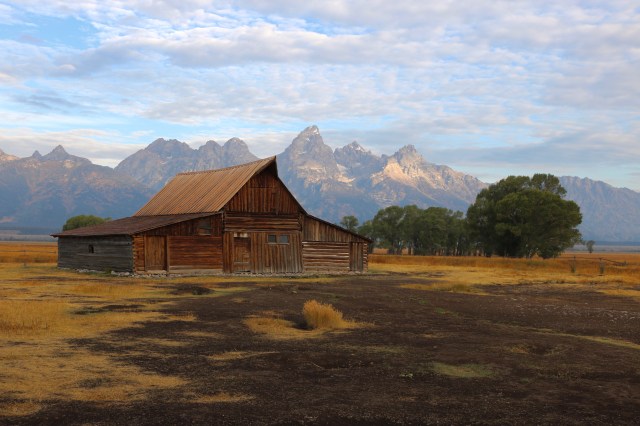
Grand Teton National park includes the Teton mountain range which is a spectacular series of granite peaks thrust upward by the push of the Teton Fault, the valley below (Jackson “Hole”) and the Snake River that winds its way through it.  Whilst nearby Yellowstone was created in two years, this park took more than 50 years to incorporate due to local resistance, overcome in the end and with support (and pressure!) from John D. Rockefeller who had bought up land for the park.

We saw some great wildlife – a distant but very large Grizzly on top of a bison carcass, a lone wolf and a couple of black bear (the one below is chewing on what looks like a deer). One of the highlights was finally seeing Moose – both a bull early in the valley, and best of all a mother and calf that wandered into our resort one evening.  These members of the deer family are gentle giants, just beautiful to see up close like this.


This area was settled by mountain men trapping for fur; braving a hostile environment – remote, with poor soil, bears, wolves and of course the bitter winters.  Today’s Jackson bears little resemblance to this pioneer environment.  It’s a great town – attractive, classy and friendly; we enjoyed great restaurants and some good shopping.  It’s joined Queenstown and Cape Town in our short list of favourite escape destinations.

We explored Jackson Hole Mountain resort – 4,100 vertical feet of nearly all advanced and intermediate skiing, the largest (continuous) rise in the U.S.  No snow for us in September, but the views were expansive, and down below we tested ourselves on the Ropes course and the vertical Bungy, plus some relaxing in the beautiful village.  One of the trip highlights so far was going to the Rodeo – an awesome experience with a party atmosphere, a shot of adrenaline and a lot of skill.

This is one town we will definitely visit again.  All photos of Jackson Hole and Grand Teton here – next stop, the inspiring Yellowstone National Park.


Digging for Dinosaurs

In Thermopolis, Wyoming, we had the incredible privilege of spending a day at the Wyoming Dinosaur Centre working as palaeontologists.

This institution has the unusual advantage of having its museum sited very close to its digs, so provides a rare opportunity for people to experience field work in conjunction with visiting the museum itself.

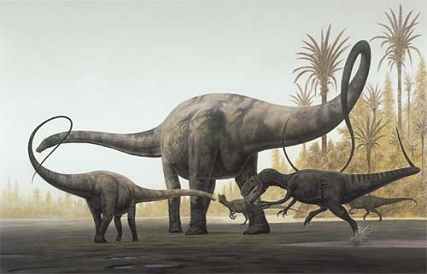
We worked on an active site (code: ATYA) containing what the museum believes to be a Diplodocus fossil: a large Jurassic plant-eater found in the Morrison Formation (see pic below).  A number of the bones were already exposed through earlier digging, and we continued with our oyster knives and brushes to continue the search.  At the end of the session, Matthew posed for a photo and as he loosened the final sheet of mud rock a small dark bone piece popped out of the earth!!  It wasn’t identifiable in isolation, but will be catalogued with the other finds as they complete this part of the dig.

diplodocus.scene

We ‘prospected’ on another hillside for marine fossils as this area was on the edge of a large inland sea and we found quite a few small fossilised squid, looking (and listening) carefully for rattlesnake which are very common in the area.

We also spent some time in the lab, cleaning the bones ready for presentation.  This is painstaking work, and brings a completely new appreciation for the field.  We worked with toothbrushes and dental implements, and eventually with a drill for the tougher removal of stone from the fossil.  The whole process is somewhat therapeutic, if requiring incredible patience!

Lastly we had a private tour of the Museum by our guide for the day – Andrew – who is the Hill Manager for the site.  The museum has some rare and fantastic specimens, including one of the few Archaeopteryx specimens in the world: Earth’s first bird.  When Darwin published his theories of evolution, he surmised that there would be transitional species that demonstrated features of both an ancestral and a new descendent group – his critics noted the absence of such as a fossil as evidence against this theories.  Just two years after publication of On the Origin of Species, the first Archaeopteryx fossil was discovered demonstrating both reptilian and bird features such as feathers (you can see these in the photo below).  We were surprised to learn that today’s birds are actually the direct descendants of dinosaurs…

Other cool fossils in the museum (and also still embedded in the field) included fossilised tracks, an awesome snapshot of time with a bird eating a fish and then being caught itself at the water’s edge by an even larger predator fish.

A fantastic experience from a small but excellent institution.  All Thermopolis photos here: next stop, a luxury break in Jackson Hole, Wyoming at the edge of the Grand Tetons.

Where the buffalo roam…

We’ve spent nearly a week in South Dakota, a concentration of attractions in a small area around the historical Black Hills – a place sacred to the Lakota Sioux Indian tribe but also rich in Western history.

Mount Rushmore was awe inspiring – far more spectacular than we had envisaged and a tribute to one man’s vision.  The carving took 14 years to complete, with Borglum (the sculpter) dying just a few months before completion.

Across the Black Hills, the immense Crazy Horse mountain honors one of the great leaders of the Native Americans.  Only partially complete, it is vast in its scale and ambition – funded entirely by private donations and visitor revenue.

IMG_5051

This area is a treasure chest of parks: Jewel Cave National Monument, Wind Cave National Park and of course Custer State Park where we stayed.

Wind Cave is one of the largest cave systems in the world – 143 miles mapped to date and an estimated 90-95% remaining!  We went down about 200 of its 500 feet depth, somewhat intimidating if you are claustrophobic but an opportunity to experience TOTAL darkness.

Custer State Park is famous for its herd of about 1600 Bison and this was certainly one of our highlights – experiencing them both in the park and then unexpectedly in our lodge area one morning!   It’s hard to imagine these herds so large that they stretched to the horizon – just driving through a small herd was intimidating enough.

Other highlights included a Daddy / Daughter hike to Cathedral Spires, a brisk swim in beautiful Sylvan Lake, and some family adrenalin at the Adventure Park.

All Custer photos here – next stop, digging for dinosaurs in Wyoming.


The Badlands

We really felt as though we had arrived in the West as we entered Badlands National Park, South Dakota.  Immense rock structures stretch across the landscape, surrounded by  endless grass prairie.  The structures are a result of both deposits (the area was at some point covered in prehistoric forests, inland seas) and erosion, as about 500,000 years ago the Cheyenne and other rivers started to wash away the softer material leaving the park as we see it today.  Whilst harsh, they are beautiful, with subtle and constantly changing colours as the light moves during the day.

We saw quite a lot of wildlife – Deer, Bighorn Mountain Sheep, Prairie Dog, Pronghorn and some glimpses of Bison in the distance.   The Prairie Dog towns were a lot of fun, the girls thought they were adorable (“can you have Prairie Dogs as pets”).

Our cabin felt pretty remote out on the prairie – we were one mile from the homestead, which itself was about 9 miles from the nearest town: Interior – population 67.  It’s pretty dark out there when the sun goes down!

We had great fun at 1880 Town, a museum that has gathered a bunch of buildings from the era between 1880 to 1920 and filled them with authentic period pieces.  Best of all was dressing up in gear from the era and hanging out in the town, including an old saloon.  The girls’ imaginations went wild – very quickly they were a team of cowgirl vigilantes of sorts taking on a slew of bad guys with their guns (and girl-power attitude).

No visit to the region (or at least driving on I-90 here) is complete without visiting the only remaining Corn Palace (yes – you did not misread this, a building part made out of corn), and of course Wall Drug.  After seeing scores of roadsigns, we had to visit this institution from the 1930’s that made its name and fortune by giving out free iced waters to parched travellers traversing the state.

Ana’s propensity to convert nouns to verbs generated a new addition to the trip vocabulary – “Hey Amelie – let’s double-adapt“.  Meaning: let’s watch the same program at the same time.

All Badlands photos here: next stop The Black Hills and Custer State Park

Waterparks and Waterfalls

After the culture of Chicago it was now the kids turn with aquatic  heaven at Noah’s Ark in Wisconsin, billed as America’s Largest Waterpark.   Despite the heavy rain (“hey, we’re wet already”) and cold wind at times, everyone had a fun time.


We crossed the mighty Mississippi, a grand sight and a mental milestone in our journey west.

These legs were about getting some distance in – next stop was Sioux Falls, South Dakota with its small but nice zoo (for Ana) and the falls that give the city its name.

All the guidebooks largely wrote off this portion of the drive – but this was our first introduction to the prairie and we loved it.  So vast and picturesque in many parts with an endless sky and ribbons of motorway stretching to the horizon.  We expected dry and bare, however this was fertile country although it reminded us of the 1930s Dust Bowl when this part of the world had up to 75% of its fertile topsoil blown away due to a disasterous miscalculation of the weather patterns, mass migration and newly introduced mechanisation.  It was America’s worst environmental disaster – and potentially new challenges ahead with the rapid depletion of the Ogallala aquifer that changed the course of history for these dry parts of the country, and underpins the existence of many out here.

All photos here: next stop, Badlands National Park.


The Windy City and a very big lake

We took a pretty leisurely drive from Grand Rapids to Chicago, hugging Lake Michigan and visiting two scenic spots on the way; South Haven – a pretty beach town – and Indiana Dunes National Lakeshore.  At both, we were blown away by the size of the lake – it looks and feels like the ocean.  It has large beaches, massive sand dunes, Baywatch style life guards – and even waves….although no risk of sharks, one of Matthew’s personal phobias!  The only obvious clue that you weren’t actually on the coast was a noticeable absence of that distinct ocean smell.

Matthew had not been to Chicago since his earlier consulting days, and for the rest of the family it was a new destination and experience – one that everyone enjoyed.  After some accommodation hiccups we found ourselves a great city pad in South Loop, about a block from WholeFoods (so good to cook for yourself when on the road!), some great restaurants and about 10 minutes drive to some world class culture.

We visited the Field Museum and saw Sue – the largest and most complete T-Rex discovered to date, the Tsavo Lions (of “Ghost and the Darkness” infamy), as well as being lucky enough to see a special exhibition of the Terracotta Warriors.  We also squeezed in a visit to the Shedd Aquarium and spent a morning checking out the iconic architecture along the river.

The kids LOVED Millennium Park, a fantastic if sometimes controversial addition to the city.  Built above a city railroad yard, it has some inspired sculptures including the Cloud Gate and Crown Fountain, an extensive kids slide complex and an awesome climbing wall.  We had to drag them away.  Exhausted….

By contrast, for the adults The Art Institute was amazing – such a concentration of quality pieces, particularly the Impressionist and American Modern Art collections.  It’s always a privilege to see famous works, but there was also a great exhibition on America’s ‘Fall’ after the Great Depression.

This slideshow requires JavaScript.

Last but certainly not least, we spent a relaxing and thoroughly enjoyable day with Matthew’s Aunt and Uncle – Robyn and Jerry – who Matthew sees on average every 15 years or so.  Having seen them in New York less than a year ago, the statistics are improving dramatically!

Chicago was a fantastic city (see all photos here) – very classy but without the overwhelming density and crazy energy of New York.  We will definitely be back, we literally skimmed the surface this time around.  A week of art, culture (and civilisation!) has been great – now it’s the kids turn as we hit waterparks in two states….

Art & History in Grand Rapids

Grand Rapids was originally in our itinerary as a stopover between visiting family in Canada and Chicago.  Although our route changed, we stuck to our plans so we could visit Frederik Meijer Gardens & Sculpture Park which looked pretty cool in our pre-trip research.

It turned out to be a great stop – the city has a small but quality history museum (apparently one of the oldest in the US) that the kids loved – think Robot Zoo, National Geographic Earth Explorers et al.

However, the Gardens and Sculpture Park was the winner – no better way to appreciate these wonderful pieces of art than in an immaculately manicured and lush landscape.  It may not be on your regular itinerary, but if you are in that part of the world, definitely worth a visit.  Some sculpture highlights below, and all photos from Grand Rapids are here.

This slideshow requires JavaScript.

No more posts.